How it works
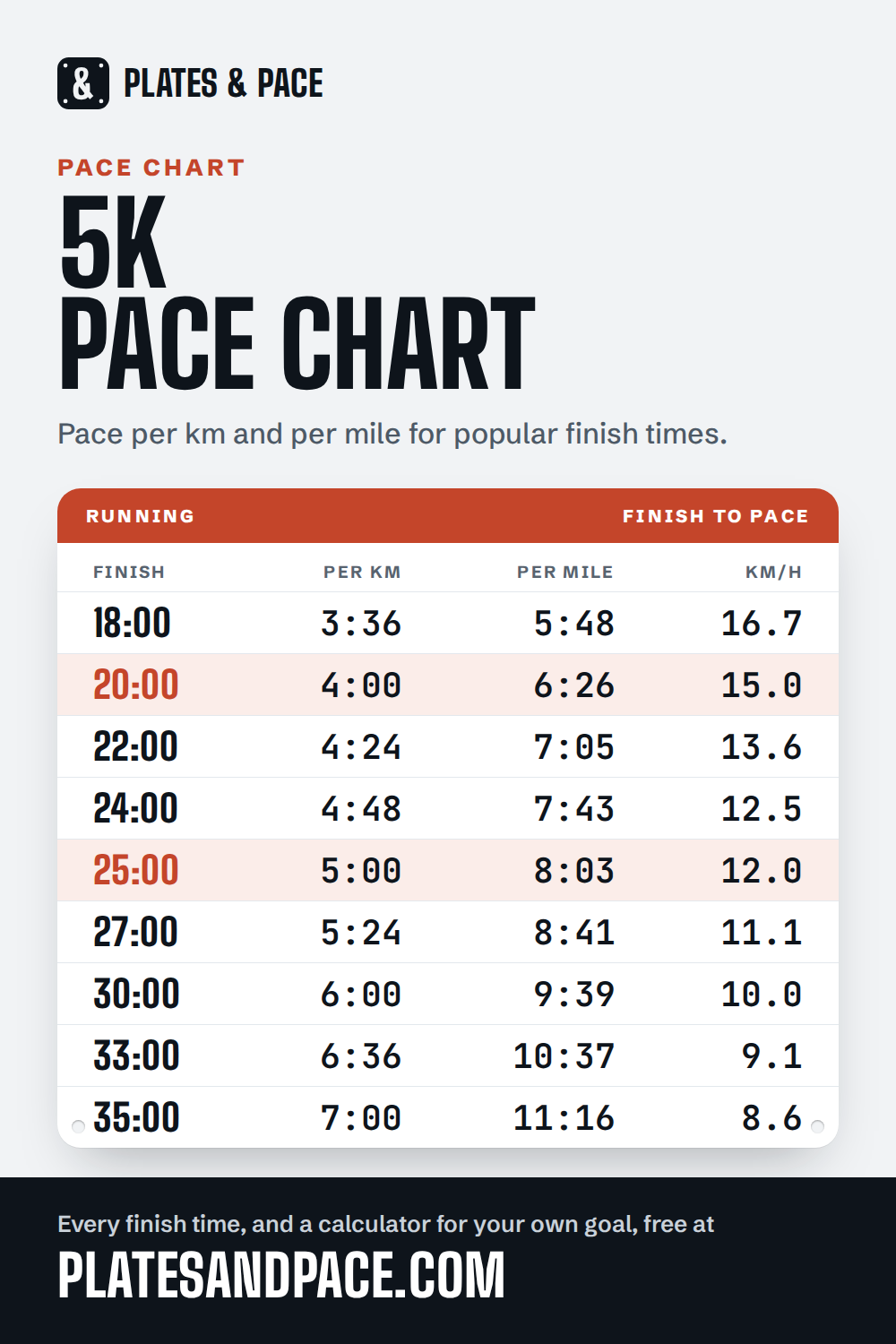
Find your goal in the Finish column. The next two columns give the average pace to hold per kilometer and per mile, and the split columns show what your watch should read at the first kilometer and the first mile.
A 5K is short enough that the first kilometer shapes the whole race. It is easy to start too fast, because the pace feels easy with fresh legs and a crowd around you. The 1 km column is the number to check.
The formula
pace per mile = finish time ÷ 3.1069
pace per km   = finish time ÷ 5
split at x km = finish time × x ÷ 5      (even pace)

paces are rounded down to the whole second
1 mile = 1.609344 km
Worked example
For a 5K in 25:00:
- Pace per mile: 25:00 ÷ 3.1069 = 8:02.8, which rounds down to 8:02 per mile.
- Pace per km: 25:00 ÷ 5 = 5:00.0, which rounds down to 5:00 per km.
- Halfway at even pace: 12:30.
5K goal paces
These goals have their own pages with splits for every mile and kilometer, checkpoint times and a negative-split plan.
- 20 Minute 5K Pace: 6:26 per mile, 4:00 per km
- 25 Minute 5K Pace: 8:02 per mile, 5:00 per km
- 30 Minute 5K Pace: 9:39 per mile, 6:00 per km
Why your watch disagrees with the chart
Race distances are measured along the shortest line a runner could take. Weaving through crowds and running wide on bends adds distance, and a GPS track is not exact, so a watch can show a little more than 5 km at the finish.
On a 5K, every 1% of extra distance is 50 m. At 5:00 per km, the pace of a 25:00 finish, that is 15 seconds: hit every split on your watch and you can still finish 15 seconds slower than planned for each 1% your route runs long.
The fix is to pace by elapsed time at the official markers. The 1 km and 1 mile columns give the time your watch should show as you pass each one.
Printing this chart
The page prints cleanly: the header, menus and side panels are left out, so the 61 rows of the chart fit on paper. For race day, the pace band generator makes a strip for your own goal to tape around your wrist: 5 times for a 5K by the kilometer, or 3 by the mile, plus the finish.
Save this chart
Questions
How do I use a 5K pace chart?
Find your goal time in the first column and read across. For a 25:00 5K the row reads 8:02 per mile, 5:00 per km and 5:00 at 1 km: the average pace to hold, then the time on your watch at each marker if you run evenly.
How do I convert pace per km to pace per mile?
Multiply the pace per kilometer by 1.609344. A 25:00 5K is 5:00.0 per km, and 5:00.0 × 1.609344 = 8:02.8 per mile, which this chart rounds down to 8:02. To go the other way, divide pace per mile by 1.609344.
What if my goal is not in the chart?
The chart covers 15:00 to 45:00 in steps of 30 seconds. For any other time, type it into the calculator at the top of the page: it gives the average pace, halfway split and speed, and the split for each of the 5 kilometers or 3 miles, with the option of a negative split.
Are the paces rounded?
Yes, down to the whole second, because a pace that was rounded up would miss the time. Holding the pace shown brings you in on the finish time or just inside it: by less than a second per kilometer, which is under 5 seconds over a 5K. The calculator shows the exact pace to a tenth of a second under the result. The split columns use the exact pace, so they always match the finish time.
Add this calculator to your site
Running club, coach or blog? You can put this calculator on your own site for free. Copy the code below into your page’s HTML. The calculator updates itself whenever we improve it.
The short script lets the frame grow to fit the calculator on your page. Please keep the credit line underneath it.